
The untold story of Prabhkiran Singh — the IIT Bombay engineer who built one of India’s first D2C fashion empires from a slum in Mumbai, and is now choosing to walk away from it after 14 years.
It is a rare kind of exit. And it deserves a rare kind of examination — not just of how Bewakoof was built, but of what that building actually cost, and what it ultimately produced.
The Engineer Who Never Wanted a Desk Job
He graduated with a degree and one firm conviction: a 9-to-5 job was not going to happen.
His first attempt at building something independent was Khadke Glassi — a lassi café he ran just outside IIT Bombay from February to September 2010. Eight months in, it shut down. The experience was a failure by any conventional measure, but it clarified something essential: Singh was not the kind of person who could work for someone else. He needed to build.
His IIT batchmate and future co-founder, Siddharth Munot, took a different path after graduation — joining an education startup. But both men were circling the same instinct: that they wanted to create something independently, something entirely their own.
In 2010, with April Fool’s Day approaching, they registered a domain. The name they chose — Bewakoof, meaning “fool” in Hindi — was deliberately absurd, anti-corporate, and exactly the kind of thing every sensible person around them advised against. That was precisely the point.
The Tin Shed: 2011
Bewakoof launched in 2011 out of a tin-shed office on the top floor of a building in a slum in Mumbai. Monthly rent: ₹6,000. Starting capital: ₹30,000. Investors: none. Business experience: none.
Customer queries were handled directly by the founders. Every complaint, every compliment, every order confirmation — Singh or Munot. This was not a lean startup methodology; it was a necessity. But it also gave the brand something that no amount of marketing spend can manufacture: genuine intimacy with its early customers.
The Growth Arc: From T-Shirts to 100 Crore
Bewakoof’s expansion was methodical rather than explosive — each phase building on a foundation laid carefully in the one before it.
Key Milestones
2011
Launch from Mumbai slum office. ₹30,000 capital. Seed funding secured within 6 months.
2012–14
75,000 Facebook fans. Expanded from t-shirts into hoodies, notebooks, and phone covers.
2015–17
Bollywood merchandise partnerships — Gangs of Wasseypur, Sholay, Bewakoofiyan. Deals with Yash Raj Films, Red Chillies, T-Series.
2018–19
Global IP licenses — Disney, Marvel, DC, Archie, SpongeBob. First Indian D2C fashion startup to cross ₹100 crore in revenue. Raised ₹80 crore from Investcorp.
2021
Raised ₹90 crore from IvyCap Ventures, Investcorp, and Spring Marketing Capital.
2022
Aditya Birla Group’s TMRW acquires 70–80% stake. Valuation: ~₹200 crore.
Crossing ₹100 crore in revenue made Bewakoof the first Indian D2C fashion startup to reach that milestone. It was a commercial validation, but also a signal to the broader market: a brand built around irreverence, community, and graphic t-shirts could scale into a serious business.
The Acquisition and What Came After
In December 2022, TMRW — Aditya Birla Group’s digital fashion arm — acquired a 70–80% stake in Bewakoof at a valuation of approximately ₹200 crore. The deal brought Bewakoof into a portfolio that included The Indian Garage Co., Wrogn, Urbano, and Nobero, and gave the brand access to Aditya Birla’s supply chain expertise and institutional retail infrastructure.
For Singh, it was also the moment the company he had built became, in a structural sense, no longer his. The majority shareholder was now one of India’s largest conglomerates. The scrappy slum-office operation had become a line item in an ABG earnings call — and a significant one, at that. TMRW managing director Ashish Dikshit noted in a Q3 FY26 earnings call that Bewakoof, after a period of slower growth post-acquisition, was now expanding at 40–50% annually.
Singh remained as CEO through the transition, continuing to lead the brand he had spent 14 years building. But the context had changed. The decisions, the direction, the ownership — none of it was his in the way it once had been.
The Exit: Reading Between the Lines
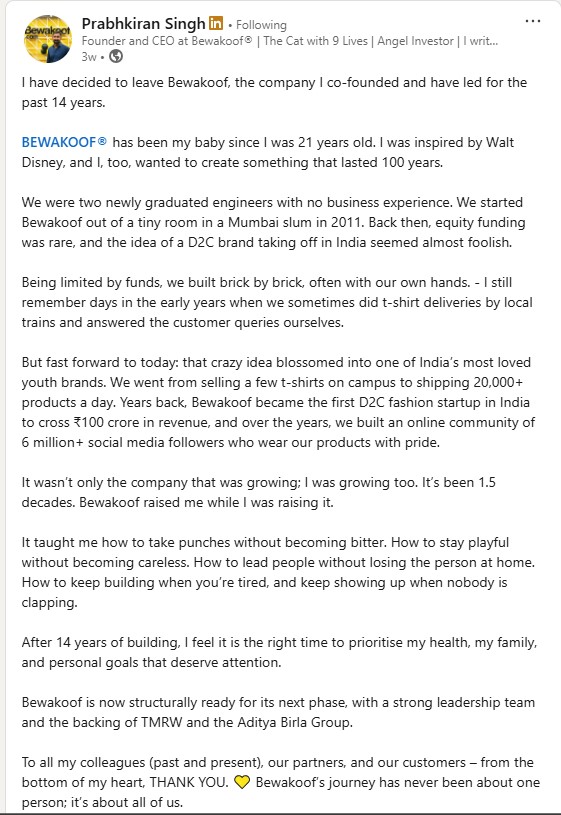
Singh’s announcement in February 2026 was unusually candid. He did not dress his departure in the language of “new opportunities” or “exciting next chapters.” He said clearly that he was leaving to focus on his health, his family, and personal goals that had been deferred for more than a decade.
Singh also wrote something that is worth sitting with: “Bewakoof raised me when I was raising it.” Fourteen years is not just a professional tenure — it is a substantial portion of an adult life. A clean break, for both founder and brand, was not a failure. It was an honest acknowledgment of what each needed next.
5 Takeaways From the Bewakoof Story
Bold brand identity beats safe positioning
Naming a brand “Bewakoof” was a risk that became the brand’s greatest asset — instantly memorable, immediately differentiated, and deeply resonant with its audience.
Culture-driven content builds before budgets do
Memes and relatable humour on Facebook built Bewakoof’s earliest community before the brand had marketing spend. Community came first; scale followed.
Start with a niche, then broaden deliberately
Quirky graphic t-shirts for college students was a specific, defensible starting point. Only after that niche was owned did Bewakoof expand into adjacent categories.
IP partnerships amplify reach without diluting identity
Bollywood and global franchise collaborations gave Bewakoof access to massive existing audiences while reinforcing — not replacing — its core brand personality.
A strong brand voice outlasts its founder
Six million followers and 40–50% post-acquisition growth is evidence that Bewakoof’s brand identity became genuinely independent of the person who created it.
Knowing when to leave is part of building well
Singh’s exit at 36, with the brand healthy and growing, is not a retreat. It is the final act of a founder who understood what the company needed — including what it needed him to do next.
Bewakoof began in a tin shed with ₹30,000 and two engineers who had no idea what they were doing. It ends Singh’s chapter as a ₹200 crore business inside one of India’s largest conglomerates, growing at 40–50% annually, with a brand that millions of young Indians recognise without being told what it stands for.
That is not a small thing. And the fact that its founder is choosing health and family over the company he calls his “firstborn” is, in its own way, the most honest possible ending to the story.