Fellow Entrepreneurs, Let’s Cut Through the Diplomatic Niceties
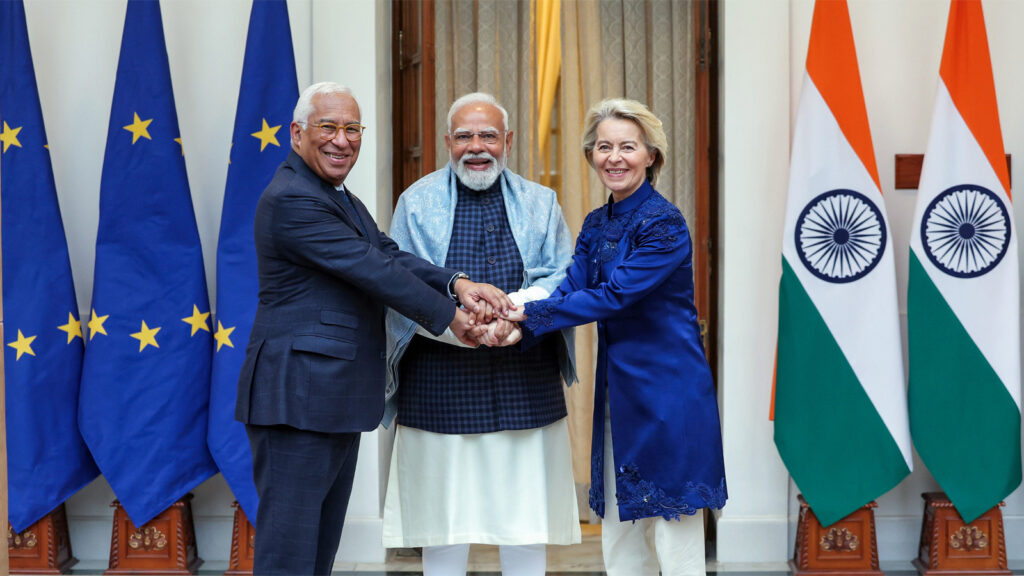
On January 27, 2026, while the world was busy doom-scrolling through trade war headlines and geopolitical anxiety, something extraordinary happened. India and the European Union didn’t just sign a trade agreement – they forged what European Commission President Ursula von der Leyen unabashedly called the “mother of all deals.”
Now, I know what you’re thinking. “Another trade deal. Another round of diplomatic back-patting. Another press conference with carefully rehearsed platitudes.” But here’s where you’d be egregiously mistaken.
This isn’t diplomatic theatre. This is the most consequential economic opportunity Indian entrepreneurs will encounter in their professional lifetimes – and I’m not given to hyperbole.
After eighteen years of negotiations – eighteen years of bureaucratic wrangling, geopolitical posturing, and the kind of diplomatic patience that would test a saint – we now possess unfettered access to 450 million of the world’s most affluent consumers. If you’ve been waiting for a propitious moment to scale your enterprise, to export with impunity, or to think with genuinely global ambition – this, unequivocally, is it.
But let me be pellucid about something: opportunities of this magnitude don’t announce themselves with fanfare and then wait patiently for you to catch up. They reward the prescient, the audacious, and the swift. They punish the complacent, the procrastinators, and those who mistake analysis for action.
The Numbers Every Entrepreneur Should Internalize (Not Just Read)
Let’s eschew the abstract and talk concrete business fundamentals. This agreement creates a free trade zone worth $27 trillion – that’s a quarter of global GDP. Not a trivial slice. Not a marginal opportunity. Twenty-five percent of the entire world’s economic output.
India-EU trade has already surged by a staggering 90% over the past decade, reaching $136.5 billion. We’re now targeting $200 billion by 2030. But here’s the detail that should make every export-oriented entrepreneur sit up straighter: 96.6% of Indian exports will now enter European markets with either reduced or zero tariffs.
Think about the ramifications for your margins. Consider your newfound competitive positioning. Contemplate your ability to systematically undercut competitors who lack this preferential access. This isn’t a minor trade advantage – this is a fundamental restructuring of the competitive landscape.
What This Means for Your Business: 12 Game-Changing Opportunities (That Demand Your Immediate Attention)
1. Export to Europe Without Incinerating Capital on Tariffs
Here’s the unvarnished truth: Europe is eliminating tariffs on 96.6% of Indian exports. That 10-15% you were hemorrhaging on duties? It’s now extinct. That margin is yours to either capitalize upon or deploy strategically to price with predatory aggression against your competition.
And let’s not mince words – if you’re not already identifying European distributors and retailers, you’re not being prudent. You’re being negligent.
Action Item for the Astute: If your enterprise operates in textiles, leather, gems and jewelry, marine products, pharmaceuticals, or engineering goods – commence identifying European distributors and retailers with alacrity. First-mover advantage isn’t just real; it’s often the difference between market leadership and market irrelevance.
2. Tap Into 102 Service Subsectors (While Your Competitors Are Still Reading the Fine Print)
For service-based enterprises, this is nothing short of a golden ticket to the most lucrative markets in human history. The agreement provides access to 102 service subsectors including:
- IT & Software Development: Already our métier, now with formal, institutionalized market access
- Consulting & Professional Services: CA firms, legal advisors, business consultants – the knowledge economy awaits
- Financial Services: Fintech, banking, insurance – where Indian innovation meets European capital
- Education & Training: EdTech, skill development, online learning platforms
- Healthcare Services: Telemedicine, healthcare IT, medical tourism support structures
Entrepreneur Insight (That Should Be Obvious But Apparently Isn’t): Europe is aging precipitously. Their demographic trajectory is inexorable. They need our young, prodigiously skilled workforce. They need our cost-effective, innovative solutions. Position yourself as the indispensable bridge, or watch someone else do it while you deliberate.
3. Scale Your Team with European Talent (And Obliterate Geographic Constraints)
The mobility pact transcends mere visa facilitation – it’s about constructing genuinely global, distributed teams that operate with seamless fluidity. You can now:
- Deploy your team to Europe for client engagements and strategic projects with minimal bureaucratic impediments
- Recruit European specialists for your Indian operations without Kafkaesque visa nightmares
- Establish satellite offices or subsidiary entities in the EU with substantially reduced friction
- Deploy contractual service suppliers and independent professionals across borders
Growth Hack (For Those Who Understand Competitive Positioning): Leverage this mobility advantage when pitching European clients. “We possess seamless, institutionalized mobility access” isn’t just a competitive advantage – it’s a market differentiator that providers from countries without analogous agreements simply cannot match.
4. Source World-Class European Equipment at Economically Rational Prices
Operating a manufacturing unit? A production facility? A food processing plant? European machinery tariffs are experiencing a dramatic diminution:
- Machinery: The near-complete elimination of 44% tariffs means you can now afford genuinely superior equipment
- Automotive Components: Complete duty elimination materializing after 5-10 years
- Industrial Equipment: Unfettered access to German precision engineering, Italian design excellence, French innovation
ROI Play (For the Numerically Literate): Superior equipment translates to elevated productivity which manifests as improved margins. Calculate what upgrading your machinery could accomplish for your output and quality metrics. If the numbers don’t compel immediate action, you’ve miscalculated.
5. First-Mover Advantage in a $4.74 Billion Annual Savings Ecosystem
The agreement generates approximately €4 billion in annual duty savings. This capital isn’t accruing to government coffers – it’s flowing to businesses that act with expedition and strategic acuity.
Let’s be explicit: While your competitors are still navigating bureaucratic minutiae and requesting “more information,” you could be systematically capturing European market share with superior pricing, enhanced margins, and unassailable positioning.
Strategic Imperative: Don’t wait for complete implementation. Don’t wait for perfect conditions. Don’t wait at all. Commence building relationships with European buyers, distributors, and partners immediately. When tariff reductions materialize, you’ll possess established channels while others are still cold-calling.
6. Diversify Away from US Market Volatility (Or Accept Unacceptable Risk)
Let’s acknowledge the geopolitical reality with unflinching honesty – with the United States imposing 50% tariffs on Indian goods, concentrating your entire export strategy on a single market isn’t just risky. It’s potentially catastrophic.
This EU agreement provides you with:
- A stable, predictable, rules-based market alternative
- Diminished dependency on any single trading partner
- Enhanced negotiating leverage with other global markets
- Strategic flexibility during periods of geopolitical turbulence
Risk Management (For Those Who Practice It): Even if your current focus is predominantly US-oriented, develop your EU strategy with urgency. Market diversification isn’t just prudent business practice – it’s existential necessity in an increasingly volatile global trading environment.
7. Protect Your Brand with Geographical Indications Recognition (And Command Premium Pricing)
If you’re commercializing traditional Indian products – whether Darjeeling tea, Basmati rice, Kanchipuram silk, or regional handicrafts – the planned Geographical Indications Agreement provides juridical protection against counterfeiting and brand dilution.
Brand Value Proposition: This transcends mere legal protection; it’s a premium pricing opportunity of considerable magnitude. European consumers demonstrably pay substantial premiums for authentic, legally protected products with verifiable provenance.
8. Access Capital and Forge Strategic Partnerships (While Indian Entrepreneurship Is Ascendant)
This agreement signals to European investors, venture capitalists, and private equity firms that India represents a stable, attractive market with formal, institutionalized trade architecture. The implications for capital access:
- Substantially facilitated fundraising from European VCs and PE firms
- Joint venture opportunities with established European companies
- Technology partnerships and lucrative licensing arrangements
- Access to European markets through strategic, mutually beneficial partnerships
Funding Strategy (For the Capital-Constrained): Update your pitch deck immediately. “Strategically positioned to leverage the India-EU FTA for aggressive European expansion” constitutes a compelling growth narrative for investors seeking exposure to one of the world’s fastest-growing major economies.
9. Reduce Compliance Burden with Self-Certification (And Accelerate Cash Flow)
The agreement incorporates simplified customs procedures through self-certification protocols. No more interminable waiting for government certification for every shipment.
Operational Efficiency (That Directly Impacts Your Bottom Line): This materially reduces delays, paperwork, and associated costs. It translates to faster delivery to European customers and dramatically improved cash flow dynamics.
10. Leverage Technology Transfer for Transformative Innovation
The agreement includes explicit provisions for:
- Digital trade cooperation frameworks
- Green and sustainable technology transfer
- Innovation partnerships with European research institutions
- Renewable energy collaboration initiatives
Innovation Opportunity (For the Forward-Thinking): Partner strategically with European companies on technology transfer arrangements. They possess cutting-edge technology; you possess intimate market knowledge and substantial cost advantages. That’s not just a winning combination – it’s a blueprint for market dominance.
11. Build a Sustainable, Socially Responsible Brand (Because European Buyers Actually Care)
The agreement emphasizes women’s economic empowerment, robust labor rights, and stringent environmental standards. This isn’t merely regulatory compliance – it’s a substantial market opportunity.
European consumers and B2B procurement entities increasingly mandate ethical sourcing and demonstrable sustainable practices. This isn’t virtue signaling – it’s purchasing criteria.
Marketing Edge (For Those Who Understand European Markets): Position your enterprise as FTA-compliant with impeccable ESG credentials. This provides access to premium European buyers who categorically refuse to engage with suppliers lacking these standards. And these buyers pay premium prices.
12. Gain Competitive Intelligence Through Expanded Networks (Because Information Is Currency)
With enhanced mobility and facilitated business travel, you’ll have unprecedented opportunities to:
- Attend premier European trade shows and industry exhibitions
- Visit prospective clients and partners for face-to-face relationship building
- Understand European market trends, consumer preferences, and competitive dynamics firsthand
- Cultivate relationships that mature into lucrative, long-term contracts
Business Development (For Those Who Recognize That Relationships Drive Business): Budget for European market research trips. The insights, relationships, and market intelligence you acquire will generate returns that dwarf the initial investment.

Why the Timing Is Perfect (Or Why Geopolitics Just Became Your Business Advantage)
Let’s discuss strategy with unflinching candor. The United States just imposed 50% tariffs on Indian goods – not as a negotiating tactic, but as policy. China’s relationship with the West oscillates between cold war rhetoric and economic interdependence. The global trading system is fragmenting along geopolitical fault lines.
This is precisely when you need market diversification. Not as some abstract risk management exercise, but as existential business imperative.
Europe represents something increasingly rare in contemporary geopolitics:
Stable Regulatory Environment – Predictable, rules-based trade architecture. No capricious presidential tweets upending your export strategy overnight.
High Purchasing Power – 450 million consumers with substantial disposable income and sophisticated taste. These aren’t aspirational markets; these are actual buyers with actual money.
Growing Demand – Particularly acute for services, IT solutions, and sustainable products. European markets aren’t saturated; they’re evolving, and they need Indian solutions.
Strategic Geopolitical Alignment – At a time when the global order is experiencing tectonic shifts, having Europe as a trade partner provides strategic ballast.
As Prime Minister Modi astutely observed, this partnership “will strengthen stability in the international system” during times of “turmoil in the global order.” For entrepreneurs navigating global markets, stability isn’t just comforting – it’s monetizable. Predictability equals profitability.
Sector-Specific Opportunities: Where to Focus Your Strategic Energy
If You’re in Textiles & Apparel: Trade Minister Piyush Goyal projects 6-7 million new jobs in this sector alone. That’s not incremental growth – that’s a fundamental restructuring of India’s textile economy. Commence identifying European fashion brands, retailers, and B2B buyers who require reliable, quality-conscious Indian suppliers. The Europeans appreciate craftsmanship; demonstrate yours.
If You’re in IT/Software: You already possess global reputation and technical prowess. Now you have formal market access and mobility provisions. This is your opportunity to transcend the outsourcing model and evolve into genuine partnerships – potentially even strategic acquisitions of European technology firms. The capital is available; the market access is formalized. What’s your excuse?
If You’re in Manufacturing: With substantially reduced costs for European machinery and components, you can upgrade your production capabilities while your finished goods simultaneously gain preferential access to European markets. That’s not just a double win – it’s a competitive moat that your rivals will struggle to replicate.
If You’re in Pharmaceuticals: Europe’s demographic trajectory is incontrovertible – aging populations require pharmaceutical solutions. India is the pharmacy of the world. The mathematics here isn’t complicated. The opportunity is prodigious.
If You’re in EdTech/Online Services: Europe is digitizing at an accelerating pace. They need platforms, solutions, and services that function at scale. Indian technology companies have demonstrated they can build global products. Now you have the market access to commercialize them across 27 countries.
If You’re in Consulting/Professional Services: Enhanced mobility provisions mean you can serve European clients with on-site presence. Construct hybrid delivery models that synergize the cost advantages of Indian operations with on-ground European engagement. This isn’t outsourcing; this is global service delivery.
Your Action Plan: What to Do Next (And Why “Later” Isn’t an Option)
The agreement requires legal review and parliamentary ratification, with implementation anticipated by the end of 2026. But sagacious entrepreneurs don’t wait for perfect conditions to materialize – they prepare while others procrastinate, they position while others pontificate, and they profit while others are still “gathering more information.”
Immediate Actions (Next 30 Days – Not 30 Weeks):
- Assess Your Export Potential with Brutal Honesty: Which of your products or services could genuinely compete in European markets? Not which ones you hope might work – which ones actually solve European problems?
- Research European Markets with Granularity: Which countries in the EU align most closely with your offering? Germany values engineering precision. France appreciates design aesthetics. Scandinavia prioritizes sustainability. Match your strengths to their preferences.
- Identify Competitors with Clinical Precision: Who’s already serving these markets, and what are their vulnerabilities? Every incumbent has weaknesses. Find them. Exploit them.
- Calculate Your New Margins with Rigorous Accuracy: What will your products cost after tariff reductions? How aggressively can you price? What’s your competitive pricing threshold?
- Join Trade Bodies (And Actually Participate): Connect with FICCI, CII, or industry associations that facilitate EU trade. But don’t just join – engage. Networks are worthless unless you activate them.
Medium-Term Strategy (Next 3-6 Months – While Momentum Is Malleable):
- Attend Trade Missions (Not as a Tourist): Seek out India-EU business delegations and trade shows. But approach them strategically – identify specific buyers you want to meet before you arrive.
- Get Certifications (Because European Markets Are Rigorous): Ensure your products meet EU standards – CE marking, ISO certifications, sustainability credentials. Europeans don’t compromise on standards; neither should you.
- Find Partners (But Choose Judiciously): Identify potential distributors, agents, or joint venture partners in Europe. But remember – a bad partner is worse than no partner. Due diligence isn’t optional.
- Update Your Pitch (With Compelling Specificity): Incorporate EU market expansion into your business plan with concrete projections, timelines, and resource requirements. Vague aspirations don’t attract capital; specific plans do.
- Explore Funding (While Indian Entrepreneurship Is Ascendant): Approach investors with your European expansion strategy. The India growth story is compelling; an India-Europe growth story is irresistible.
Long-Term Planning (Next 12 Months – When Foundations Determine Outcomes):
- Test the Market (Before Committing Substantial Resources): Initiate pilot exports or small contracts. Learn the market dynamics with limited downside exposure.
- Build Relationships (Because European Business Is Relationship-Intensive): European commerce operates on trust, reputation, and long-term relationships. Invest the time. The returns compound exponentially.
- Consider Local Presence (For Serious Market Commitment): Explore establishing European entities or partnerships. Local presence signals commitment; commitment generates trust; trust generates business.
- Hire for Growth (Not Just for Operations): Recruit individuals with European market experience, cultural fluency, and established networks. They’re expensive because they’re valuable.
- Scale What Works (And Abandon What Doesn’t): Double down on successful channels and products. But have the intellectual honesty to abandon strategies that aren’t generating returns, regardless of sunk costs.
Real Talk: Challenges to Anticipate (Because Optimism Without Realism Is Delusion)
Let’s engage with unvarnished honesty – opportunities invariably accompany challenges. Ignoring them doesn’t make them disappear; it makes you unprepared.
Regulatory Compliance: The European Union maintains stringent standards on quality, safety, environmental impact, and labor practices. These aren’t suggestions; they’re prerequisites. Budget for compliance costs upfront, or budget for failure later.
Cultural Differences: European business culture differs substantially from Indian norms. Communication styles, negotiation approaches, decision-making timelines – they all vary. Invest in understanding these nuances, or watch deals evaporate despite superior products.
Competition: You won’t be alone in pursuing these opportunities. European companies will defend their markets. Other Indian firms will chase identical opportunities. Competitive advantage requires differentiation, not just participation.
Working Capital Requirements: International trade is capital-intensive. Longer payment cycles, inventory financing, letters of credit – plan your financial architecture accordingly. Undercapitalization kills more international ventures than product failures.
Exchange Rate Volatility: EUR-INR fluctuations can obliterate margins with remarkable speed. Consider hedging strategies, natural hedges through import-export balancing, or pricing structures that accommodate volatility.
The encouraging reality? Every successful Indian exporter has navigated these challenges successfully. The tariff advantages and market access you now possess make the return on investment not just worthwhile – they make it compelling. The question isn’t whether these challenges exist; it’s whether you have the fortitude to overcome them.
The Bottom Line (For Those Who Prefer Clarity Over Platitudes)
This agreement represents a fundamental restructuring of how Indian enterprises can compete in global markets. You now possess:
– Access to 450 million affluent consumers with sophisticated purchasing power
– Tariff advantages over competitors from nations without comparable agreements
– Mobility provisions that enable genuinely global team construction
– Technology transfer opportunities that can catapult you ahead of domestic competitors
– A stable, predictable regulatory framework in an increasingly chaotic global trading environment
– €4 billion in annual duty savings to compete for aggressively
But here’s the uncomfortable truth that nobody wants to articulate opportunities. Don’t wait patiently for you to feel ready. They reward the audacious, the prepared, and the swift. They punish the cautious, the over-analytical, and those who mistake deliberation for wisdom.
While the majority of Indian businesses will read about this historic agreement, discuss it extensively over chai and conference calls, form committees to “study the implications,” and eventually conclude they’ll “consider it next quarter” – you need to be among the decisive minority that acts.
The entrepreneurs who will dominate EU markets aren’t those with the best products (though that helps). They’re not those with the most capital (though that’s useful). They’re the ones who:
- Commence building substantive relationships immediately, not eventually
- Invest in comprehending European market dynamics with genuine intellectual curiosity
- Ensure their compliance and certifications are impeccable before market entry
- Test and iterate before full tariff benefits materialize
- Construct distribution channels while competition is still “gathering more information”
This Is Your Moment (But Moments Don’t Last Forever)
India has negotiated its most comprehensive, consequential trade agreement in its post-independence history. The government, after eighteen years of diplomatic effort, opened the door. But walking through it? That responsibility rests squarely on us – the entrepreneurs, the risk-takers, the builders of enterprises that will define India’s economic future.
Two decades hence, there will be Indian companies that have become household names across Europe because they seized this opportunity with both hands while it was still nascent. There will be enterprises that scaled from ₹10 crore to ₹1000 crore because they moved with strategic alacrity and operational excellence.
The only relevant question is: Will your company be among them?
And let’s be pellucid about something: This isn’t about nationalistic fervor or patriotic duty (though those are admirable sentiments). This is about cold, calculating business logic. This is about recognizing when structural advantages align in your favor and having the commercial acumen to capitalize on them.
The “mother of all deals” isn’t merely a trade agreement with impressive statistics and diplomatic congratulations. It’s a once-in-a-generation structural opportunity for Indian entrepreneurs to establish themselves in markets that have historically been challenging to penetrate.
The tariffs are being dismantled systematically. The markets are opening with unprecedented scope. The geopolitical timing is propitious – perhaps even providential.
But here’s what history teaches us about opportunities of this magnitude: They don’t announce themselves repeatedly. They don’t wait patiently for consensus. They don’t accommodate procrastination.
What you do in the next twelve months – not what you plan to do, not what you hope to do, but what you actually execute – will determine whether you’re a spectator or a protagonist in this new era of Indian global commerce.
The choice, as it always has been, is yours. Choose wisely. Choose swiftly. And for heaven’s sake, choose action over endless deliberation.
Because while you’re still “considering your options,” someone else is already meeting with European distributors, negotiating contracts, and establishing the market position that should have been yours.
About This Historic Opportunity
The India-EU Free Trade Agreement was announced on January 27, 2026, representing the culmination of eighteen years of complex, multilateral negotiations. Implementation is anticipated by the end of 2026. Projected bilateral trade: $200 billion by 2030. Current bilateral trade: $136.5 billion. Market access: 450 million European consumers. Tariff elimination: 96.6% of Indian exports.
Ready to Pursue European Markets with Strategic Intent?
Commence by connecting with your industry association, attending trade missions, and rigorously researching EU market requirements for your specific products or services. First movers will capture disproportionate market share. Followers will compete for what remains.
What’s your European expansion strategy? Which sectors do you believe will benefit most substantially? What are you waiting for? Share your strategic thinking – or better yet, share your initial successes as you begin this journey.
The deal is done. The opportunity is real. The only variable that remains undetermined is your response.