

Is this the future of parenting — or just designer babies with a Silicon Valley rebrand?
Kian Sadeghi flunked college at 20, received a Peter Thiel fellowship, and then determined that his course of action would be assisting rich people in maximizing babies’ IQs through prep in utero.
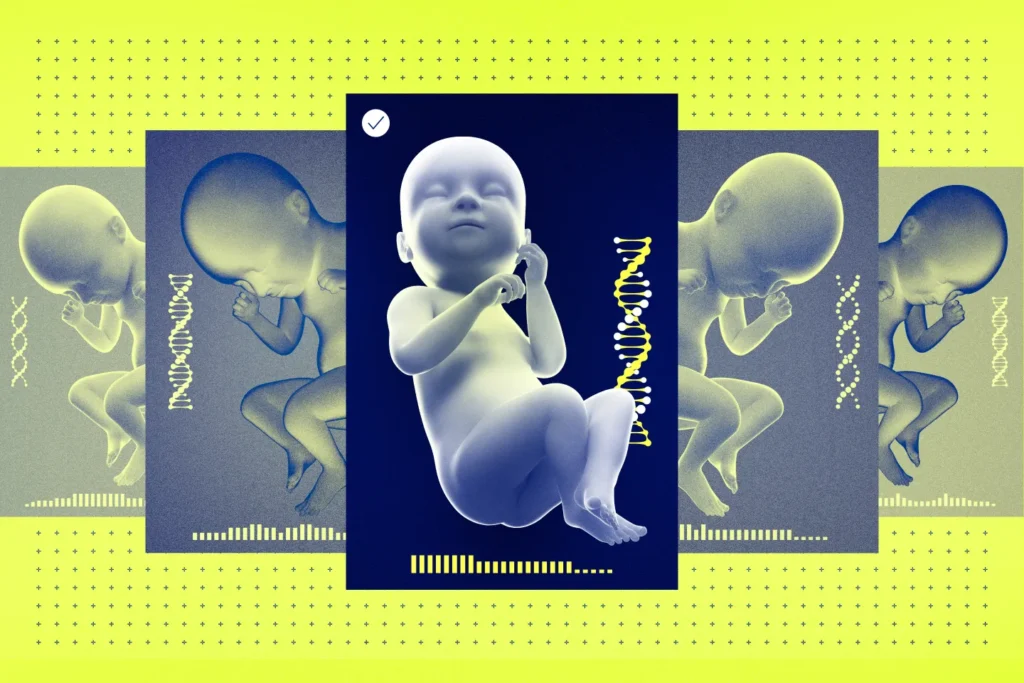
Yes, you are reading that right. We are talking about a startup that literally lets you test your embryos for intelligence, eye color, height, and more than 2,000 other characteristics, and then “choose” your “fittest” embryo. The product, named Nucleus IVF+, has already raised $34 million from VCs like Founder’s Fund and 776 VC, founded by Alexis Ohanian.
“If that sounds like a plot from Black Mirror, as suggested by a Stanford dropout sporting a Patagonia fleece, you’re in good company. But trust us, Sadeghi is completely serious about making embryo choice the next wave of human optimization, and ironically, it’s a pretty smart business model.”
The value proposition: “Optimize your family’s genetic future.”
Cost of this product: A mere $30,000. In addition to your $15,000 to $25,000 IVF cycle.
And people are actually paying for it.
So, Essentially, This Business—Now a Company—Does This:
900+ hereditary diseases (all those things that are agreed to be good to screen for)
Bodily features such as eye color, height, hair color (becoming spicy)
Intelligence predictions using polygenic scores (full controversy mode)
Mental health concerns, such as depression, anxiety, autism, and bipolar disorder.
Genetic susceptibilities for diseases such as Alzheimer’s, Diabetes, Heart conditions, and cancers
“And then you get a comparative analysis of all your embryos like you’re buying a product on Amazon, and you decide which one you want to put in.”
Their latest product offering? “Origin” – a set of nine AI models of genetic optimization that debuted in October 2025. Open-weight, population-varying, promising to forecast everything from cancer risk to IQ.
“The science sounds impressive.”
“The ethics?”
“Well, that’s where it all gets a…”
The Backlash Was BRUTAL
“Hold up,” was what the medical community collectively said.
Critics aren’t pulling punches when it comes to:
“One of the journalists found that her predicted risk for diabetes changed from 53% to 10.9% when Nucleus updated its model. That’s not exactly confidence-inspiring when you’re making life-altering decisions about which embryo to implant.”
Twitter was having a field day:
“This literally constitutes eugenics with a change of branding and, of course, superior PR.”
“What happens when the ‘optimized’ kid doesn’t turn out as planned?”
“So we’re just casually normalizing designer babies now?”
The Marketing Stunt Question: Connecting the Dots
But let’s look at where it gets interesting from a business point of view. This whole saga—this whole controversy? This may be the exact reason.
Evidence FOR This Being Brilliant Marketing:
Controversy = Publicity: Every angry news article is free publicity for its target audience
First-Mover Boldness: While other companies use “disease prevention” as a cover, it takes courage
Founder Story: 20-Year-Old Thiel Fellow Challenging Reproductive Medicine Market
Premium Positioning: $30K price point screams exclusivity, not accessibility
Strategic Provocation: “Sadeghi actively works with couples to help him optimize for intelligence—he’s leaning INTO the controversy.”
Evidence AGAINST Pure Marketing:
On the other hand, it has to be noted that there are some legitimate scientific endeavors taking place. They’ve partnered with a company called Genomic Prediction, which has analyzed over 120,000+ embryos. They’ve also released open-weight AI models and are collaborating with legitimate IVF clinics, such as Beverly Hills.
And how has Sadeghi, faced with criticism, reacted?
“Nothing strengthens science like good skepticism.”
Moreover, there’s a legitimate market for this. The world’s IVF market alone will top $36 billion by 2030. “Rich parents are already shelling out $25K for IVF. Another $30K to optimize their kid’s genetic blueprint? Easy splurge.”
Where Sadeghi Actually Has a Point (Sort of)
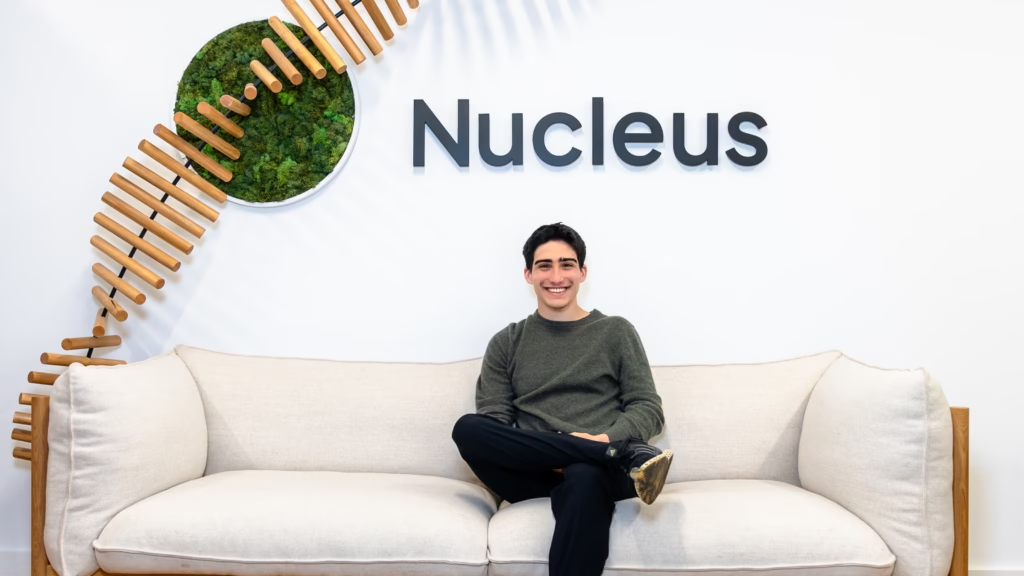
Well, this person isn’t completely wrong in pointing out such trends:
The Market Timing Is Perfect: IVF has become mainstream now (1.2 million cycles a year in the US)
Biohacking and Life Extension: Already, rich people are shelling out fortunes on these trends
AI Boom: Genetic prediction has become closer to reality
Optimization Obsession: Silicon Valley’s obsession with optimization has extended to everything
The Technology Exists:
Polygenic risk scores ARE used in medicine.
Embryo screening for severe genetic disorders is a common practice.
The models CAN find patterns in huge genetic databases.
But it all falls apart when you consider this:
“Assigning intelligence, personality, and other complex behaviors to genetic screening is analogous to attributing traffic congestion to a lone red traffic light.”
Intelligence has many factors: genes, environment, education, nutrition, trauma, and so many other things. To break it down to a polygenic score is just reductive.
The Real Issue Here – A Case of Silicon Valley Hubris in Reproductive Medicine

This sounds like classic founder brain:
“I disrupted the payments/delivery/social media industries. Therefore, I must also be able to disrupt human evolution.”
The part that has problems isn’t in funding genetic research or in assisting parents in coping with and preventing their children from being inflicted with devastating diseases. This includes:
Unvalidated predictions being pushed as actionable insights
Marketing to consumers before peer review validation
Capitalizing on parental worries about providing their children with “every advantage.”
Enacting a form of genetic inequality, whereby access to optimization can only be afforded by those with means
IVF with genetic screening is not consumer technology that has no harm. This is about which lives will be chosen and which will not, based on predictions from AI that could be utterly wrong.

The Business Model: Premium Pricing for Genetic Anxiety
Revenue Structure:
Nucleus Embryo: $5,999 (software)
IVF-Nucleus Full Service IVF+: $30,000+
Target Market:
Ultra High Net Worth
Silicon Valley tech elite
Families who are in IVF cycles and can afford advanced features
Biohackers applying optimization philosophy to reproduction
The Psychological Sell:
Parental love + fear = “will pay any amount”
FOMO: offering your child “every advantage.”
Control in an uncertain process
Status signaling (access tothe latest tech)
Optimization mindset extension
With a customer price of $30K, their goal of $36 million in revenue would require no more than 1,200 customers. In a realm where people already spend $100K+ for longevity optimization, that’s not a tall order.
What Would Make This Legitimate?
To: Everyone
Actually do the science RIGHT
Publication of peer-reviewed literature related to prediction accuracy
Long-term longitudinal studies of “optimized” children
Make confidence intervals and limitations transparent
Halt the promotion of undeveloped predictions as insights
“Wait for clinical trials before promoting interventions.”
“If Continue Research (Sadeghi, also known as “continue research”) funds real, independent research that passes peer review, then that’s wonderful.”
But using provocative tweets and cryptic AI models to market a $30K offering to worried parents? That’s not research—it’s marketing.
The Verdict: Visionary Or Marketing Guru Hiding as a Scientist?
Here’s my thinking: it’s a combination of both.
The Bigger Picture: What This Truly Represents
Each day, Americans encounter the intersection of entrepreneurship, science, and publicity in contemporary biotechnology. This playbook is familiar:
Make bold, controversial claims
Create massive buzz
Position yourself as a visionary, challenging conventional wisdom
Monetize the attention
Hope that science catches up with the marketing
“Sometimes this yields true innovation (mRNA vaccines, anyone?). Sometimes it’s Theranos.” The question is: which one is the Nucleus?
Conclusion
By now, Nucleus IVF+ represents sleep-aware beautification related to reproduction. One is offering revolutionary AI-based reproductive services, the other is placing a bet on niche, sciency-sounding products that appeal to wealthy consumers.
The challenge? One is offering a paradigm shift in human reproduction with AI models and a 25-year-old’s fire in the belly.
If the research lives up to its claims, passes peer review, and proves accurate, that would be a revolution. Until then, this seems like the intersection of Silicon Valley’s obsession with optimization and reproductive medicine, science be damned.
Question for readers: Can Kian Sadeghi be considered a misunderstood pioneer on the brink of a revolution in human evolution itself? Or is this merely the most complicated product launch in biotech history disguised as a genetic breakthrough? Either way, I’m not screening my embryos for IQ just yet.