
What happened, When It happened, and Why It Matters
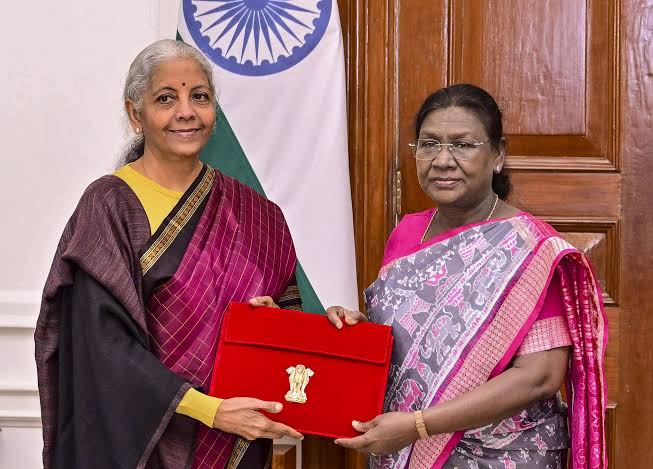
On February 1, 2026, Finance Minister Nirmala Sitharaman stood in the Lok Sabha and delivered her ninth consecutive Union Budget. The speech ran for one hour and twenty-five minutes. It was deliberately concise. Sitharaman opened by saying the government has chosen the path of reforms over rhetoric. The tone for each thing that came next was set by that one sentence.
The total budget size is Rs 53.5 lakh crore. Fiscal insufficiency is pegged at 4.3% of GDP, down from 4.4% last time. Capital expenditure, the capital spent on erecting lasting means like roads and factories, has been hiked to Rs 12.2 lakh crore, from Rs 11.2 lakh crore. The debt- to- GDP rate is being brought down to 55.6%.
Sitharaman organised the entire budget around three duties she called “Kartavyas.” The first Kartavya is accelerating growth through manufacturing in seven strategic sectors. The alternate Kartavya is fulfilling aspirations and structural capacities, which is where education, skills, and youth employment sit. The third Kartavya is erecting long- term public security and stability. Every single announcement in this budget maps back to one of these three pillars.
The terrain matters too. The United States has placed a 50% tariff on Indian exports. China confined rare earth mineral exports in 2025. India conducted Operation Sindoor in May 2025. And yet, India’s GDP grew at 7.4% in FY26. This budget isn’t a response to extremity. It’s a response to the occasion, specifically the occasion to make India less dependent on other countries for critical technology, raw materials, and manufacturing capacity.
WHAT THIS BUDGET DECLARED FOR ENTREPRENEURS
1. Three Separate Finances of Rs 10,000 Crore Each
The government announced three distinct charges of Rs 10,000 crore, each targeting a different part of the business ecosystem.
The first is the Fund of Finances for Startups. A fresh Rs 10,000 crore has been pumped into this fund. The capitalist flows through SEBI-registered venture capital and necessary investment funds to reach early-stage and growth-stage startups. This isn’t an annuity. It’s structured capital that is managed by professional fund managers. However, the pool just got larger if you are raising a seed round or a Series A. More importantly, government capital in the system pulls private capital in alongside it. That is how fund ecosystems actually work.
The second is the SME Growth Fund. Another Rs 10,000 crore, this time devoted to nurturing what the government is calling” champion SMEs.” The idea is to identify small and medium enterprises with high growth potential, give them equity capital rather than just debt, and help them expand into larger competitive units. Sitharaman specifically said this fund will incentivise enterprises predicated on select criteria. The Self-Reliant India Fund, which was set up in 2021 with a total corpus of Rs 50,000 crore, is being expanded by Rs 2,000 crore in FY27 to keep micro enterprises alive with access to trouble capital.
The third is Biopharma SHAKTI. Rs 10,000 crore over five times for domestic biopharma manufacturing, covering disquisition, scale-up, and product facilities.However, biosimilars, or pharmaceutical inventions, If you are used in biologics.
2. Credit Guarantees Doubled for Startups
From Rs 10 crore to Rs 20 crore, the loan guarantee coverage for startups has been increased. The figure has been reduced to just 1% for loans falling under 27 priority sectors. For micro and small enterprises more widely, the credit guarantee cover has been increased from Rs 5 crore to Rs 10 crore, which unlocks a fresh Rs 1.5 lakh crore in credit over five times. Exporter MSMEs can now access term loans of over Rs 20 crore under the increased guarantee cover. A new scheme provides financial support specifically to first- time entrepreneurs from depressed backgrounds.
3. TReDS Overhaul: The Payment Problem Gets Fixed
If you have ever supplied goods or services to a government body and waited months to get paid, this is the reform that addresses it. Trade Receivables Discounting System, TReDS, is now being made mandatory for all purchases from MSMEs by central public sector enterprises. Over Rs 7 lakh crore has already moved through TReDS. Now the government is layering four changes on top of that.
First, credit guarantee support is being introduced for invoice discounting on TReDS, so financiers actually feel confident lending against those invoices. Second, the Government e-Marketplace is being linked directly to TReDS, so financiers can see real-time data on government procurement from MSMEs. That visibility makes financing faster and cheaper. Third, TReDS receivables are being converted into asset-backed securities, which creates a secondary market and improves liquidity. Fourth, the whole system is being positioned as the transaction platform for all CPSE purchases from MSMEs, not just an optional route.
4. Tax Holiday Until 2047 for Cloud and Data Centre Companies
Any foreign company that provides cloud services to global customers by routing workloads through data centres located in India will not pay tax on that income until 2047. That is not a typo. Twenty-one years of tax exemption. The condition is that services to Indian customers must go through an Indian reseller entity. A safe harbour of 15% on cost has been offered for related-entity data centre service providers. The IT services safe harbour threshold has been raised from Rs 300 crore to Rs 2,000 crore.
AI workloads are growing exponentially. Data localisation norms are tightening everywhere. Hyperscalers are looking for new geographies. India is positioning itself directly at that intersection. For Indian entrepreneurs building in the data centre, cloud infrastructure, or AI space, this creates a massive co-investment opportunity alongside the global tech giants who will now have a strong financial reason to build here.
5. Semiconductor Mission 2.0: Rs 40,000 Crore
India Semiconductor Mission 2.0 has been launched with a Rs 40,000 crore outlay through the Electronics Components Manufacturing Scheme. The first phase already attracted investment commitments at double its original targets. ISM 2.0 expands the scope to semiconductor equipment manufacturing, full-stack Indian intellectual property, industry-led research and training centres, and supply chain strengthening. If you are in electronics manufacturing or any adjacent sector, this is a multi-year demand tailwind backed by serious government capital.
6. Rare Earth Corridors in Four States
Dedicated rare earth corridors are being established in Odisha, Kerala, Andhra Pradesh, and Tamil Nadu, covering the full value chain from mining through processing, research, and manufacturing. India holds the world’s third-largest rare earth reserves. China restricted exports of these minerals in 2025. The government had already approved a scheme for sintered rare earth permanent magnets with an Rs 7,280 crore outlay. These corridors build on that. Expected investment is Rs 42,000 crore. Expected job creation is 50,000. Basic customs duty has been exempted on capital equipment used for critical mineral processing. For entrepreneurs in advanced materials, mineral processing, or the equipment and technology that supports these operations, this is one of the most deliberately funded industrial policy windows India has opened in years.
7. 200 Legacy Industrial Clusters Being Revived
Two hundred old industrial clusters across India are being brought back to life with policy support, credit access, and technology. If your business is located in one of these clusters, or if you supply into them, this directly expands your potential order book and customer base.
8. Corporate Mitras: Compliance Gets Cheaper
The government is partnering with ICAI, ICSI, and ICMAI to train accredited para-professionals called “Corporate Mitras.” These professionals will help MSMEs meet compliance requirements at an affordable cost, particularly in Tier II and Tier III towns. Compliance costs are one of the biggest hidden drains on small business profitability in India. This is the first serious structural attempt to address that.
9. Defence Sector Opens Up Further
Defence allocation is Rs 7.85 lakh crore. Capital outlay for modernisation is Rs 2.19 lakh crore, up 21.84%. Rs 63,733 crore is earmarked for aircraft and aero engines. Basic customs duty has been exempted on raw materials for aircraft parts in defence maintenance, repair, and overhaul. An increasing share of procurement is being directed toward indigenous manufacturing. Defence production has already grown threefold over the past decade. The government is targeting defence exports of Rs 50,000 crore by 2028-29. If you are in aerospace, defence electronics, drones, or any component of the defence supply chain, the pipeline just got significantly longer and more predictable.
10. MAT Rate Cut and Buyback Tax Simplification
The Minimum Alternate Tax rate has been reduced to 14%. Buyback tax treatment has been unified as capital gains for all shareholders, removing an earlier asymmetry that complicated corporate planning. These are not headline grabbers, but they directly reduce the tax friction for growing businesses.
WHAT THIS BUDGET DECLARED FOR STUDENTS
1. Education-to-Employment and Entrepreneurship Committee
A high-powered standing committee has been constituted specifically to bridge the gap between education and employment. It will recommend measures focused on the services sector as a core driver of growth, assess the impact of AI and emerging technologies on jobs and skills, and target India to achieve a 10% global share of services by 2047. This committee is the institutional mechanism that connects classroom learning to actual job creation. It is the first time a formal body of this kind has been set up at this level.
2. AVGC Content Creator Labs in 15,000 Schools and 500 Colleges
The animation, visual effects, gaming, and comics sector is expected to need 2 million professionals by 2030. To build that talent pipeline from the ground up, the government is setting up AVGC content creator labs in 15,000 secondary schools and 500 colleges, supported by the Indian Institute of Creative Technologies in Mumbai. If you are a student interested in animation, visual effects, game design, or content creation, the infrastructure for learning these skills is being built at scale for the first time.
3. Five University Townships Near Industrial Corridors
Five university townships are being planned near major industrial and logistics corridors. Each township will house multiple universities, colleges, research institutions, skill centres, and residential facilities. The explicit goal is to create what the government is calling a “study-to-work ecosystem,” where students learn in proximity to the industries that will hire them. This is not just about building more colleges. It is about fundamentally rethinking how education connects to employment.
4. Girls’ Hostel in Every District
One girls’ hostel will be established in every district under the Viability Gap Funding scheme. There are over 700 districts in India. Sitharaman said plainly that long hours of study and laboratory work pose challenges for girl students, and this measure is aimed at removing that barrier, particularly in districts with limited residential facilities and in STEM institutions.
5. New National Institute of Design in Eastern India
In eastern India, a new National Institute of Design will be founded via a challenge route.. This responds to the demand surge in the design industry and expands access to world-class design education beyond the existing geographic concentration of such institutions.
6. Three New National Institutes of Pharmaceutical Education and Research
Three new NIPERs are being set up, alongside upgrades to seven existing institutes. A network of 1,000 accredited clinical trial centres is also being developed. If you are a student in pharmaceutical sciences or biomedical research, the institutional capacity for your field is expanding significantly.
7. Three New Ayurveda Institutes in All of India
Three new AIIAs are being established. This expands access to both education and practice in traditional medicine systems, particularly relevant for students in Ayurveda and related disciplines.
8. TCS on Education Remittances Cut from 5% to 2%
Tax Collected at Source on remittances made under the Liberalised Remittance Scheme for education abroad has been reduced from 5% to 2%. For families paying overseas tuition fees, this means less cash is blocked at the time of transfer. The same reduction applies to medical remittances. TCS on overseas tour packages has also been cut to a flat 2% with no threshold stipulation.
9. One-Time Foreign Asset Disclosure Scheme for Students and Young Professionals
A six-month, one-time foreign asset disclosure scheme has been announced, specifically targeting students, young professionals, tech workers, and relocated NRIs who have inadvertently failed to disclose small foreign assets or income. For category A taxpayers, undisclosed foreign income or assets up to Rs 1 crore can be regularised by paying 30% tax plus an additional 30%, with full immunity from prosecution. For category B taxpayers who disclosed income but failed to declare assets acquired, the limit is Rs 5 crore, with immunity from penalty and prosecution on payment of a Rs 1 lakh fee. Non-immovable foreign assets withan aggregate value below Rs 20 lakh attract no penalty at all, with retrospective immunity from October 1, 2024.
10. PM Internship Scheme Continues and Scales
The Prime Minister’s Internship Scheme, originally announced in Budget 2024-25, continues its rollout. It targets one crore youth in the top 500 companies over five years. As of recent data, 1.27 lakh internship opportunities have been posted, and approximately 6.21 lakh applications have been received. This is the largest structured internship programme in Indian history by any measure.
11. IIM Pilot to Train 10,000 Tourist Guides
A pilot programme has been launched with IIMs to train 10,000 tourist guides across 20 iconic cultural and heritage sites. This is a small-scale initiative in numbers but significant in concept. It is an acknowledgement that tourism is a legitimate employment sector and that professional training in it should come from premier institutions, not be treated as an afterthought.
12. Khelo India Mission Strengthened
The Khelo India Mission is being expanded with a focus on integrated talent development, coaching infrastructure, sports science integration, expanded competitions, and creation of training facilities. For students who are athletes, this represents a more structured and professionally supported pathway from school-level talent to national competition.
13. One Lakh Allied Health Professionals to Be Trained
Selected institutions will train one lakh allied health professionals over the coming years. This targets a specific workforce gap in India’s healthcare system and opens a structured career pathway for students in nursing, diagnostics, rehabilitation, and other allied disciplines.
14. National Mental Health Infrastructure Expansion
NIMHANS is being expanded to North India. New national mental health institutes are being planned. For students and young professionals, this is both a health resource and a recognition that mental well-being is being treated as a policy priority at the institutional level.
THE BOTTOM LINE
For entrepreneurs, this budget does three things at once. It puts serious equity capital into the system through three separate Rs 10,000 crore funds. It removes structural barriers to payment and credit access through the TReDS overhaul and credit guarantee expansion. And it opens up entire sectors, semiconductors, rare earths, defence, cloud infrastructure, biopharma, with the kind of policy support and duty exemptions that make building in those sectors financially viable for the first time.
For students, the budget does something equally important but less discussed. It is building the institutional infrastructure that connects education to actual employment. The Education-to-Employment Committee, the university townships near industrial corridors, the AVGC labs, the internship scheme, the allied health training, the design institutes, all of these are attempts to close the gap between what Indian classrooms teach and what the Indian economy actually needs. Whether they succeed depends on execution. But the intent, backed by real allocations, is there.
Sitharaman called this a “yuva shakti-driven budget.” PM Modi called it a “highway of opportunities.” Congress called it “lacklustre.” The truth is somewhere in the tension between those assessments. But the money is real. The allocations are specific. And for anyone, entrepreneur or student, trying to figure out where India’s economic future is being built, this budget is the most detailed map available.

Pingback: When The Orange Economy Becomes the New Goldmine - Soch Sutra